I haven't read it yet (I will be ordering it shortly), but in the meantime, here and some very positive comments that piqued my interest and inspired me to put it in my queue of books to buy.
Rifftide: The Life and Opinions of Papa Jo Jones provides insights into Jonathan David Samuel Jones, affectionately known as Papa Jo Jones, and one of the major innovators and influences in drum kit playing.
I'm going to immediately set expectations about this book: if you are searching for information and opinions about drumming and other drummers, this is not the book for you. I suggest that, instead, you read the information-rich chapter on Papa Jo Jones in Drummin' Men: The Heartbeat of Jazz The Swing Years. In addition to that book, my previous post, Papa Jo Jones contains a wealth of information about him. More about additional resources later in this post.
On the other hand, if you are seeking to understand Papa Jo Jones the man, along with his views on a myriad of topics then this book is a treasure. And as you come to understand him you may get a glimpse into how he came about and what molded him.
Most folks describe the book as having three parts: Paul Devlin's Preface that discusses the trials and tribulations of transcribing interviews that Albert Murray conducted with Papa Jo, then Rifftide - Jo Jones in Jo Jones' own words, and an Afterward by Phil Shaap. I would like to add the Editor's Notes, which comprise 28 pages of invaluable information that is like the Rosetta Stone for the preceding sections.
Of the principals involved in creating this book, the editor - Paul Devlin - never met Papa Jo in person. That does not diminish his importance because transcribing and making sense of the interview tapes were daunting tasks. That is not to say that Albert Murray's interview sessions were easy either. For a taste listen to the 1973 interviews that Milt Hinton conducted with Papa Jo on this page. Milt and Jo went way back and Milt also knew a lot about his family, yet Jo Jones had moments of evading or deflecting. Plus his accent - known as Locust Valley Lockjaw after an upper class section of Long Island - takes some getting used to if you are not familiar with that particular accent.
The Rifftide section is what will separate those who are seeking knowledge from those who are seeking facts. The writing (especially if you hear it in Jo's voice) is akin to receiving enlightenment from Yoda. You know there are important lessons in the words, but those lessons seem to be doled out in some oblique manner.
What I got from this section is how well read Jo was, and that he was an astute observer who could synthesize a wide array of facts and observations into some unified philosophy and way of life. That same gift for synthesis, I am sure, enabled him to make not just one - but two - major contributions to the art of drum kit playing. He moved time to the hi-hat and did things that that piece of the drum kit that nobody before him could have conceived; he took the art of brush playing to a level that is still part of every jazz drummer's vocabulary. I was also gratified to read his mention and acknowledgement of Wilson Driver, his teacher, in the book. Mr. Driver was conspicuously missing from any mention in The Drums! (which adds another dimension to Papa Jo Jones the man and the drummer.) Strangely, there is no mention of Manzie Cambell whom Papa Jo considered to be the world's greatest drummer in The Drums!
Another thing that struck me was his love of books and voracious reading habits, which was not only indicative of an amazing intellect, but probably alienated him from his peers, especially in later life. I am sure he lived in a world apart from others. One clue was his own statement that he did not know there were racial differences until he was 19. In his era and geographic location where lynchings were common that is an odd statement. All the more so because he was such an astute observer. It only reinforces my own opinion that he lived in a world of his own mind.
His recounting of names, associations and places in this section of the book painted a vivid picture of his era and influences. Indeed, I recall that on the last track of The Drums! he exclaims "Butterbean and Susie" while playing a duet with Willie The Lion Smith. I had no idea who or what he was talking about until I read his account of how they took him in. It's the small details that portray the drummer as the man, instead of the other way around.
The final section is the Afterward by Phil Shaap. Not only is Phil a musician, but he spent a lot of time with Jo and shares insights that neither Albert Murray nor Paul Devlin would have. Louis Proyect's intriguing article discusses Phil's relationship with Papa Jo during the course of writing about a related topic. Phil, in this section of the book, is frank and exposes many facets of Jo, both flattering and not so flattering. Again, it fills in who Jo was as a man, and from Phil's vantage, also as a musician. The stories and observations are similar to Michael Stein's firsthand account titled Smiling Jo Jones. Stein also wrote what I consider to be one of the most insightful reviews of Rifftide I've encountered. I encourage you to take the time to read that review for things I missed in this one.
One resource that covers his Basie years - to a degree - is The Last of the Blue Devils - The Kansas City Jazz Story, which I highly recommend because Basie figures in this book for a number of reasons. First, by the time Albert Murray was conducting the interviews that are at the heart of this book Papa Jo and Basie were estranged. There are more than a few paragraphs devoted to implied hopes by Papa Jo that he and Basie could reconcile. Indeed, Murray co-authored Good Morning Blues: The Autobiography Of Count Basie and had a strong bond with Basie. Perhaps, as is alluded to in this book, too strong to do Papa Jo justice, but that is where Devlin and Schaap contribute subjectivity that balance any of the bias - if there ever was any - out.
Before wrapping up with my conclusions I'll share a promo video of this excellent book to which you can compare the publisher's perspective with mine.
What I gained from this is a deeper insight into one of my idols, plus a rich backdrop of history to satisfy my avocation as an amateur historian. As a drummer, this book gave me a deeper appreciation for the man upon whose shoulders we stand upon. That, to me, is priceless.
Here are a few clips of Papa Jo Jones that showcase his genius and keep his memory alive:
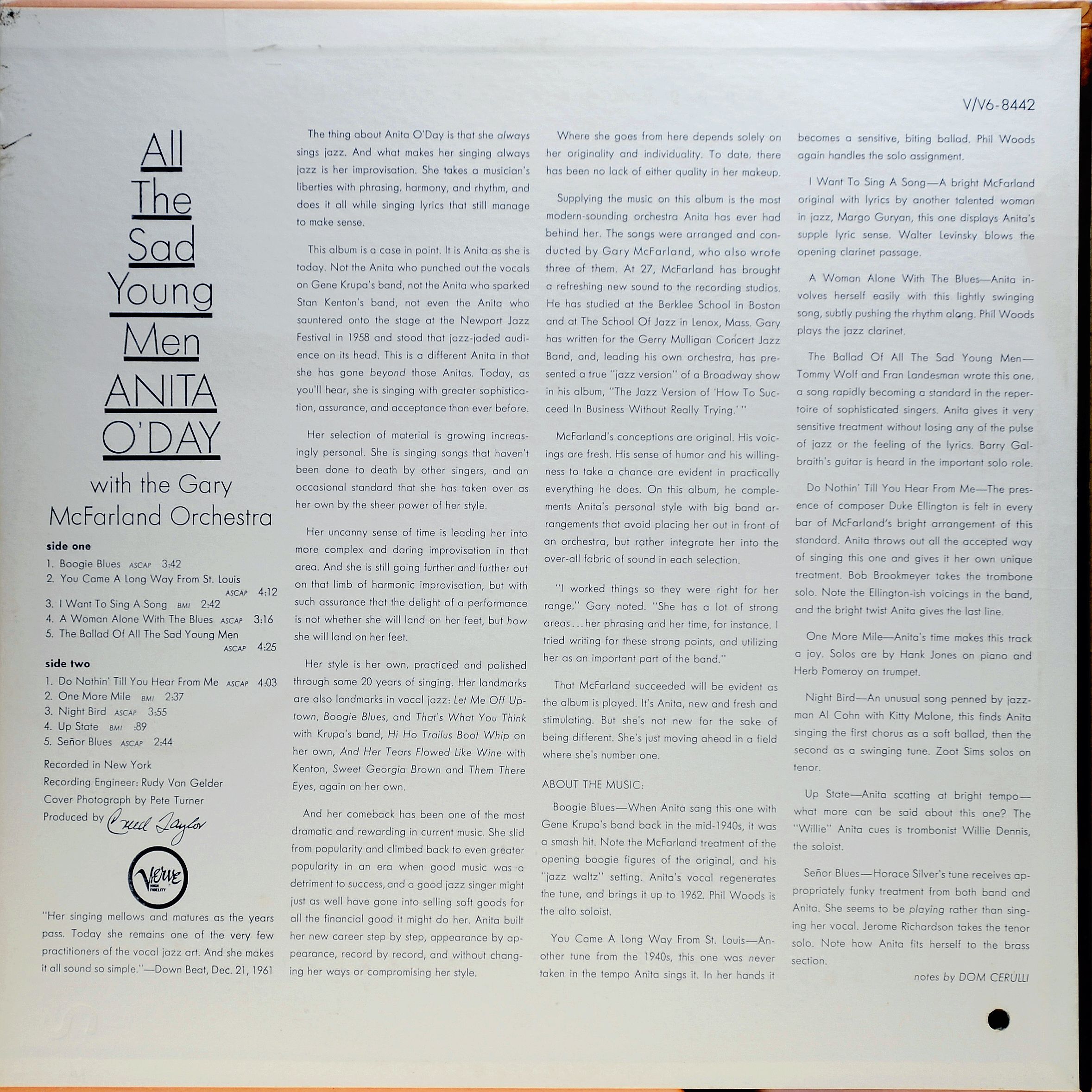
This album may have not been Anita's best, but it does rank among her better albums during her Verve years. More importantly, the way it was recorded was groundbreaking - for 1961. Finally, I am personally intrigued by the veiled reference to F. Scott Fitzgerald. Before going into all of that, here is the back cover of the album containing the liner notes. I think it makes for interesting reading. Click on the image for a much larger, readable one:
About the F. Scott Fitzgerald theory. He wrote a collection of short stories in 1926 titled All the Sad Young Men that reflected some trying situations he was experiencing. One major one was he suspected his wife Zelda of having an affair. Consider some of the song selections here: Do Nothing Until You Hear From Me, A Woman Alone With the Blues, and, of course, The Ballad of the Sad Young Men. Is there a connection? Perhaps; perhaps not. I am getting up there in years, so my theory may be more a symptom of dementia than some special insight. Note: you can listen to samples of each track by visiting this page. Here are a few of the tracks in their entirety to give you a taste of what's on the album:
Track 9 - Up State
Track 5 - Ballad of all the Sad Young Men
Remember my saying that this was groundbreaking in some aspects? Here is why, as related by Anita in Chapter XI of her autobiography, High Times, Hard Times: The orchestra recorded in New York and the arranger, Gary McFarland, sent her the tapes and charts via the mail. She showed up in a Hollywood studio to add the vocals which were recorded along with the playback of the orchestra backing her. She said all she had were charts with annotations like, "ad lib here", and stood on a box in the recording booth and provided the vocals into a mic while the backing was piped through speakers. She also mentioned that she never met McFarland until four or five years later!
If you are a recording engineer of musician today you are probably thinking, 'what's the big deal?' For one thing the only folks doing multi-track recording in 1961 were Les Paul who pretty much invented it, and a genius engineer at Atlantic Records named Tom Dowd (his story is in Tom Dowd & the Language of Music). So, in one respect, this album was groundbreaking for the way it was put together.
Recording was at Englewood Cliffs, NJ on October 16, 1961 and in Los Angeles between November and December 1961. Personnel included: Bernie Glow, Doc Severinsen, Herb Pomeroy (trumpets), Bob Brookmeyer, Willie Dennis, Billy Byers (trombones), Walt Levinsky (clarinet), Phil Woods (alto sax), Jerome Richardson (bass clarinet), Zoot Sims (tenor sax), Hank Jones (piano), Barry Galbraith (guitar), George Duvivier or Art Davis (bass), Mel Lewis (drums).
While the songs seem to fit the Fitzgerald theme I mentioned above, there are some interesting pieces thrown in. For example, Anita was doing Boogie Blues with Gene Krupa when McFarland was a toddler. Including Horace Silver's Senor Blues was a, well, hip move on the producer's part in my opinion.
All in all this is among my favorite O'Day albums, but still not in the top five. That is my personal taste. I will say that you could not go wrong with this or any of her albums from her Verve years. And, as a drummer, it is always a treat studying Mel Lewis.